Showing posts with label scarf / bufanda. Show all posts

28.12.12

GRANNY SCARF (Graphic Pattern)


BUFANDA GRANNY (Patrón Gráfico)


Several people have asked how to make the stitch for the granny scarf.  Actually, it is the same pattern as the granny stripes blanket, which you can find in many places, including Caron: GrannyStripes Afghan.  For the scarf, I make the beginning row a little differently, so I thought of drawing a graphic pattern for you:

Varias personas me han preguntado sobre la puntada de la bufanda granny.  En realidad, es el mismo patrón que la frazada de franjas de la abuelita, el cual pueden encontrar en muchos sitios, incluyendo Caron (en ingles, con gráfica): GrannyStripes Afghan.  Dado que el comienzo lo hago un poco diferente para la bufanda, pensé en dibujarles el patrón gráfico: 


I started with 15 chains, which is on the thin side (for our mild winters).  But you can certainly go wider…Just add more chains to desired width (in multiples of 4 minus 1).   
Comencé con 15 cadenas, que en realidad es algo angosta (por nuestro clima moderado).  Pero también pueden hacerla más ancha, simplemente añadiendo más puntadas hasta alcanzar el ancho deseado (en múltiplos de 4 menos 1).


Here are two more Granny Scarves I recently made:
Aquí les muestro otras dos bufandas granny que hice recientemente:


The multicolored is for the daughter of a friend.
La multicolor es para la hija de una amiga. 


In bright and pastel colors, with a white background.
Con colores pastel y brillantes, con un fondo blanco.


And the grey one is for a young lady.  With a matching hat. 
La gris oscura es para una jovencita.  Con una gorra que combina.


Pattern for the hat: Granny Hat
Patrón para la gorra: Gorra Granny


25.12.12

ICED ASCOT


CORBATA GLACEADA
(Crochet)
Made by / Hecho por: Magda


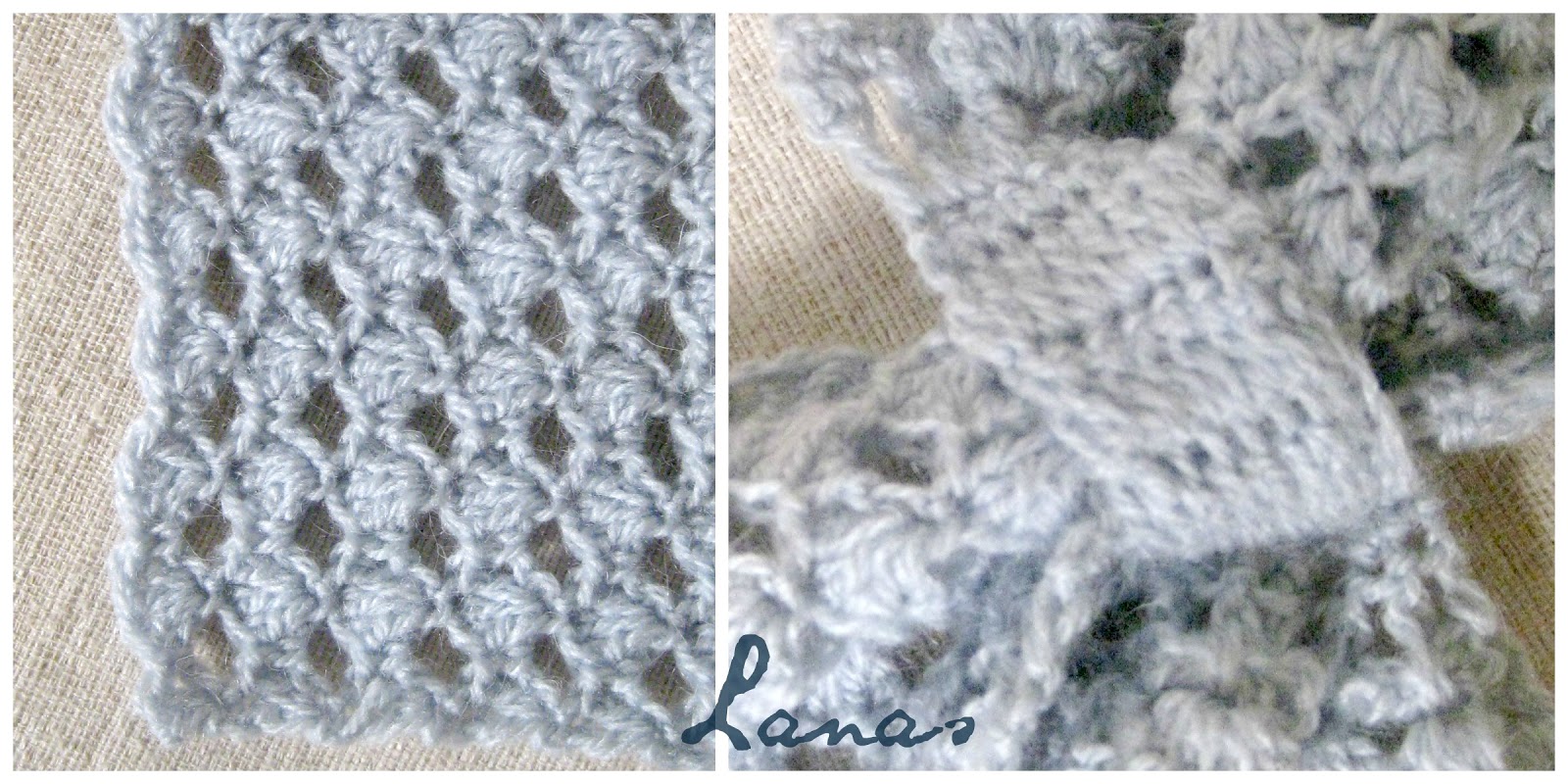
A friend from our knitting club made this cute lacy short scarf in crochet.  She used a fine alpaca yarn in light blue (similar to the original pattern).
Una amiga de nuestro club de tejido hizo esta linda bufanda calada en ganchillo. Utilizó una fina lana de alpaca en color celeste claro (similar al del patrón original).


The pattern comes from the book: Simply Crochet by Robyn Chachula. 
El patrón viene en el libro: Simply Crochet, de Robyn Chachula.


What makes it original is the loop.  It forms kind of a bow when the opposite end goes through it...thus an ascot.  And  the stitch is really beautiful.
Lo que la hace muy original es el anillo tejido.  Al atravesarlo con la punta opuesta, se cruza formando una especie de moña.  Y la puntada es realmente hermosa.  

Thank you, Magda, for sharing it with us.  
Gracias, Magda, por compartirlo con nosotros.

6.12.12

MOSAIC INFINITY


INFINITO MOSAICO
[Crochet]

Last time I shared with you the Mosaic Scarf.  After making several versions (in purples, blues, pinks and neutrals), I thought of turning it into an infinite scarf, that is a continuous circle, with no beginning nor end.

La vez anterior les mostré la BufandaMosaico.  Luego de hacer varias versiones (en morados, azules, rosados y neutrales), pensé en convertirla en una bufanda infinito, hecha en forma circular, sin principio ni fin. 


For this infinity version, I started with 162 Foundation double crochet stitches (Fdc), reaching aproximately 148 cms / 58". I think this is the perfect lenght.  If you don’t make it too long, you can wear it loose as a collar. If you don’t make it too short, you can twist it once, and wear it as a cowl.
Para esta versión infinita, comencé con 162 puntadas vareta de fundamento (Fdc), alcanzando aproximadamente148 cms / 58" .  Creo que este es el largo perfecto; si no es demasiado larga, puede usarse suelta como un collar; si no es muy corta, se puede doblar una vez y usarse como un cuello.


I used several medium yarns, in purple and grey tones.I chose a grey Angora yarn for the chain rows, for a touch of texture.
Para esta bufanda, usé varias lanas medianas, en tonos morados y grises. Para darle un toque de textura, hice las hileras de cadenas con una lana de Angora gris.


I have used this infinity scarf a lot, and I love it!  I might try it with other colors...
He usado mucho esta bufanda.  ¡Me gusta tanto!  Posiblemente la haré de nuevo con otros colores... 


2.12.12

MOSAIC SCARF (pattern)


BUFANDA MOSAICO (patrón)
(Crochet) 


I love scarves with lengthwise stripes, and that is what inspired me to create this scarf…
Me encantan las bufandas con franjas a lo largo, lo cual me inspiró a crear esta bufanda…


Here I am sharing the pattern, in case you want to give it a try:
Aquí les comparto el patrón, en caso quieran probar hacer una (más abajo en español):

PATTERN (English)

Special Stitches:

a.  The MOSAIC SCARF is made with the “Mosaic stitch”, formed by blocks of 3dc´s, which are separated in the next row by 3 chains + sc (between the 3-dc clusters). 

b.  For the first row, I used a special stitch known as “Foundation double crochet” (Fdc).  I prefer this over the chain foundation because it leaves a stretchier border.  It might take longer to make, but it is worth the effort.  If you have not tried it before, check this video in YouTube: Art of Crochet by Teresa - Chainless Double Crochet Foundation


You will need:
Worsted yarn (but you can actually use any yarn you like).  If you want to make a multi-colored scarf, change colors on every row or every other row.  I personally used one contrasting color for all even rows, and used Angora yarn to give it a bit of texture.
Crochet Hook: 5 mm (or the adequate size for your yarn)

Instructions:
1.  Cast on: 200 st, using a “double crochet foundation (Fdc)”.  [Or, if you prefer…you can always make the foundation row with chains, and then a row of dc’s.  But make sure the chain row is loose.  Using a larger hook could do the trick].

2. Turn. With new contrasting color [I personally used Angora yarn, but you can use any yarn you want for contrast], make 1 sc in the first st. * Make 3 chains, skip 3 st and make 1 sc in between 3rd and 4th dc*  (Repeat between * and *). Finish with 1 sc over the final dc.

Or you can make this chain row in the same color as the previous row, instead of a contrasting color.


3.  Turn.  Join a new color.  Chain 3 (counts as 1st dc).  *3 dcs on 3-ch space*.  Make a dc over the last st.

4> Repeat rows 2 and 3 until you reach desired width. (These samples are not wide because our winters are very mild).

Optional:  Add tassles


Next time, I will show you a “cowl version”, which is my personal favorite…


If you like crochet graphics, this will help you read the pattern (pardon the simplistic drawings!):


PATRON (Español) de la BUFANDA MOSAICO

Puntadas especiales:
a. Esta bufanda está hecho con el “punto mosaico”, formada por bloques de 3 varetas, las cuales están separadas por una fina hilera de 3 cadenas + un punto simple (entre los bloques de 3 varetas) Ver la gráfica anterior.

b. En la hilera base, usé un punto especial conocido como “Vareta de Fundamento” (en inglés: “Foundation double crochet” (Fdc). Es preferable usar esta puntada en lugar de una base de cadenas, ya que es más flexible, en lugar de la base de cadenas que son más apretadas. Lleva más tiempo, pero vale la pena.  Si no han visto esta puntada, les sugiero que vean el siguiente video en You Tube(en inglés):    Art of Crochet by Teresa - Chainless Double Crochet Foundation


Materiales:
* Lana mediana  (pero, en realidad, puedes usar cualquier lana que deseen).  Si quieren hacer una bufanda multicolor, pueden cambiar colores en cada hilera.  Personalmente, yo usé un color contrastante en cada hilera par, y escogí una lana angora para darle textura).
* Gancho: 5 mm (o la adecuada para la lana que vayan a utilizar)


Instrucciones:
1.    Hacer 200 “Varetas de fundamento” (Fdc).  [O, si prefieren…también pueden comenzar con 200 cadenas, y luego hacer una hilera de 200 varetas.  Pero asegúrense de que la hilera de cadenas no esté apretada, lo cual pueden lograr usando un gancho más grande para esa pasada].

2. Voltear.  Con un color contrastante, hacer un punto simple en la primera puntada.  *Hacer 3 cadenas.  Saltearse 3 puntos y hacer un punto simple entre la 3° y 4° vareta * (Repetir entre * y *).  Terminar con un punto simple en la vareta final.

O pueden hacer esta hilera de cadenas con el mismo color que la previa, en lugar de usar un color contrastante.

3.  Voltear.  Unir un nuevo color.  Subir con 3 cadenas (que cuentan como la primer vareta).  * 3 varetas en el espacio de 3 cadenas*  Terminar con una vareta en el último punto.

4> Repetir las hileras 2 y 3, hasta haber alcanzado el ancho deseado.

Opcional: Añada flecos en las puntas.


En la próxima ocasión les mostraré la versión infinita de esta bufanda, la cual se ha convertido en mi favorita...


26.11.12

NECK WARMER with Cables


CUELLO CON TRENZAS
(Knit / Dos agujas)


A lady asked me if I could make her a neck warmer, and this is what I came up with.
Una dama me pidió que le hiciera un cuello tejido, y esto es lo que me ingenié.


It is made with a 3x3 rib in the beginning and end, and the body consist of garter borders with 2 cables in the center. 
Está hecho en dos agujas con resorte 3x3 en el principio y fin, y el resto tiene un borde de sólo derechos con dos cables en el centro.


Finally, it is put in place with a wooden brooch…and ready to use. 
Finalmente, se decora con un broche de madera, y listo para usar.


Currently I am making another one in light purple, which I hope to show you soon…
Actualmente estoy haciendo otro en morado claro, el cual espero mostrarles pronto…

19.11.12

UP-DOWN INFINITY: other versions


BUFANDA INFINITO: otras versiones
(Knit / Dos agujas)

Here are three other versions of the “Up-Down Infinity Scarf”:
Estas son otras tres versiones de la “BufandaInfinito Arriba-Abajo” :


1. “Wine at Dusk” Up-Down (Vino al Atardecer)


Colors: Beige, wine, brown, cream, grey in angora, blackberry pink.  
Colores: Beige, vino, café, crema, gris en angora, rosado mora. 

Look how the colors change from one side to the other...
Noten cómo los colores cambian de un lado al otro de la bufanda...


Tab in Beige.


2. “Festive” Up-Down (Festivo)
(Made by/Hecho por: Beatriz)


Colors: Dark grey, beige, autum red, grey, cream in angora, olive green, mustard yellow, off-white.
Colores: gris oscuro, beige, rojo otoño, gris mediano, crema en angora, verde olivo, amarillo).  


3. “Dark Neutral” Up-Down (Neutrales Oscuros)


Colors: Black, cream, light blue, grey, camel, dark grey, light olive green.
Colores: negro, crema, celeste, gris, camello, gris oscuro, verde oliva claro.


Wooden buttons. 
Botones de madera.


Pattern (in English): Up-Down Infinity Scarf
Patrón (en Español): Bufanda Infinito Arriba-Abajo


29.10.12

UP-DOWN INFINITY (Pattern in English)


Pattern (in English):  Up-Down Infinity Scarf

[Para las instrucciones en españolBufanda Infinito Arriba-Abajo]


This is an infinity scarf (no beginning nor end), knit with circular needles, and hold together with a garter buttoned tab when folded. 


For this scarf, you will need:
*  Medium, worsted yarn (but you can actually use other similar yarns).
If you want to make a multicolored scarf, you can choose 8 colors, using each color just once, except the first which will be repeated at the end.  This can be a great stash-buster project, because you just need a little of each color. Or you can use less colors and repeat them, or even just one color. 

Note: Just keep in mind that, given the design of the scarf, some colors will appear on one side, and other in the opposite side.
For example, if you use 8 colors:
Colors A, C, E, G, I will be predominant on one side
Colors B, D, F, H, A will show on the other side.


*  Long circular knitting needles, size 5 or 5.5 mm (for worsted yarn).  I personally used larger needles (6 mm), because I like my scarves soft and airy.  Use the size you feel most comfortable with.
*  One marker:  To keep track of the start/end of each row.

This scarf is a rather easy knit.   The hardest part is the cast on, since it is done length-wise.  But once you have achieved that, it is a piece of cake.  And the outcome is worth the effort. 


Knitting Instructions:
I will write the pattern for 8 colors (A-B-C-D-E-F-G-H-I), but you can use less, alternating them as you want, or even just one.

1.  Cast on 200 St (180 st for a shorter scarf) on long circular knitting needles.
[Tip:  When counting the stitches, mark with a pin every 50 st.  This helps in the counting, so you will not get lost with so many stitches.]

Here are some YouTube videos on how to CAST ON, which are methods that can be used for casting many stitches, different from the popular “long-tail method”.

*  With 2 knitting needles: Cast on: SlowVersion
* With circular knitting needles:  Knitting On Cast-on Method - Continental
*  With the help of a crochet hook: Stretchy Knitted Cast-on, or Crochet Cast on #1 , or Crochet Caston # 2


When you have finished casting the 200 st, join with a simple knot the yarn end at the beginning and end of the cast on, just to secure it.  Place a marker to keep track of start/end of each row.  Make sure the stitches are not twisted.  Now you are ready to start knitting your scarf on the round…

Row 1-4> (With COLOR A)  All knit.  Pass marker (pm).

There are 4 rows of every color.  When changing color, you also change the stitch (from K to P, or from P to K)…

Row 5-8> (With COLOR B)  All purl. (pm)

Repeat 1-4 with COLOR C
Repeat 5-8 with COLOR D

Repeat 1-4 with COLOR E
Repeat 5-8 with COLOR F

Repeat 1-4 with COLOR G
Repeat 5-8 with COLOR H

Repeat 1-4 with COLOR A

If you want a wider scarf, repeat rows 1-8 once or twice, with 2 or 4 other colors, or repeat some of the previously used. 

Cast off. Weave in ends.


BUTTON TAB  (Optional)

The button tab is optional.  It is a garter strip with buttons and button holes on the other side.  Its purpose is to hold the scarf together when folded in two.  It has buttons so you can put it on, or take it off easily. 


Using COLOR A (the color of both borders), cast on 14 st.
1-40> All knit [Note: knit more rows if you made a wider scarf]
41> K2, [k2tog + make 1—for the button hole], K5, [k2tog + make 1], k3
42-46> All knit
47> Cast off.

Place buttons on the opposite side of the button holes. 


Enjoy!
Related Posts Plugin for WordPress, Blogger...